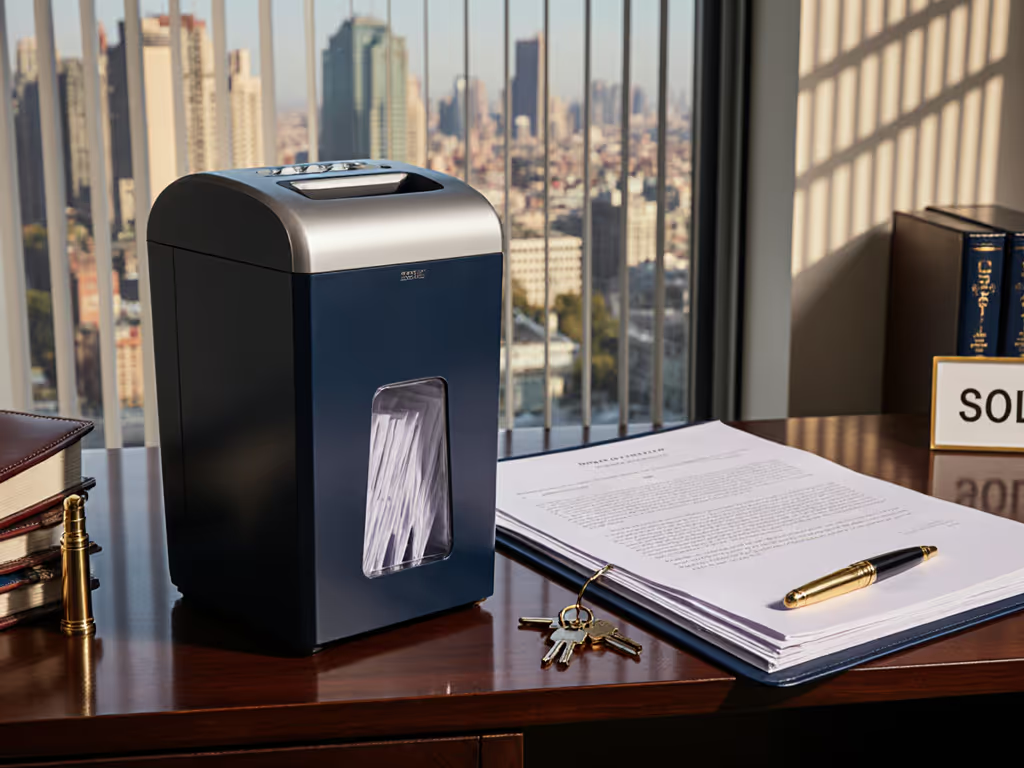
Auto Dealership Shredders: Compliance Without Overkill
By Mateo Silva • 23rd Mar
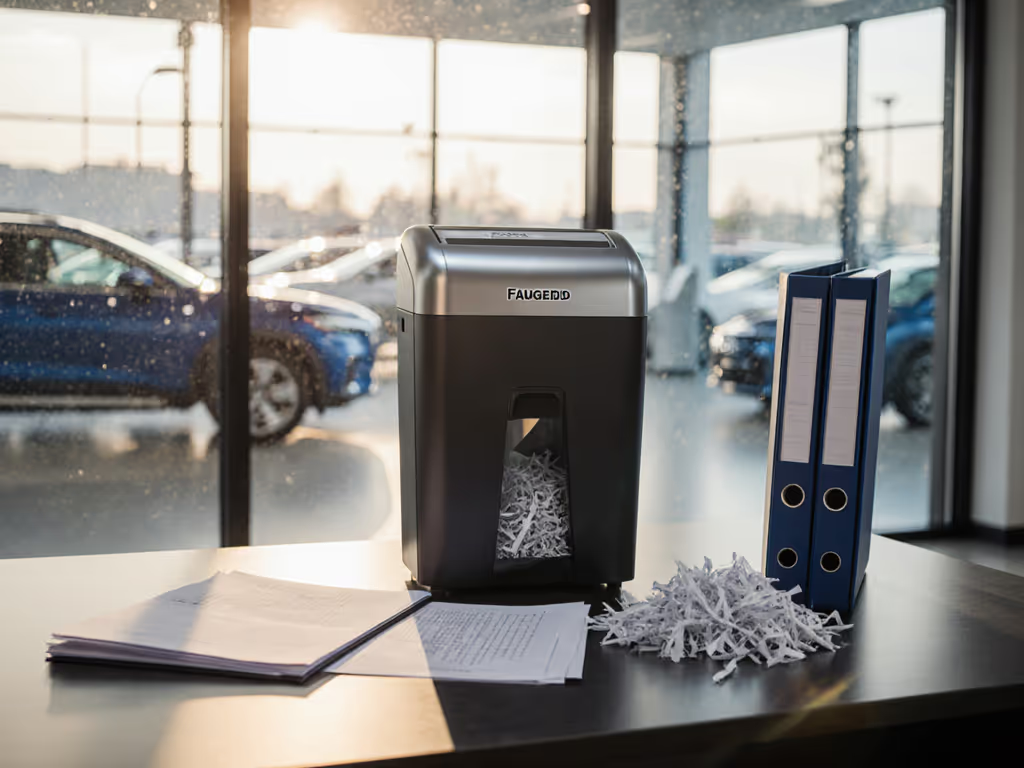
Dealerships generate a paper trail that makes compliance professionals lose sleep. Credit reports, driver's licenses, social security numbers, loan applications, payment records, and vehicle identification details flow through finance offices, sales desks, and back-office drawers daily. The regulatory pressure is real. FACTA (Fair and Accurate Credit Transactions Act) and the FTC's Red Flag Rules require secure destruction of consumer data[3][6], but the response at most dealerships is panic buying.[1] For a clear overview of applicable regulations and what "unreadable and indecipherable" really means, see our document destruction compliance guide.
Lead with impulse, and you end up with an arsenal: micro-cut shredders stuffed into tight spaces, cross-cut units gathering dust, and a facility burning hours and energy on destruction overkill that your actual document load never justified. The compliance anxiety is valid. The auto dealership shredders you purchase should reflect your risk profile and volume, not security theater.
Let's map what you actually need to shred, how to right-size your approach, and where spending more only buys headache.
The Problem: Dealership Paper Creates Unique Compliance Exposure
Vehicle document security isn't optional in dealership operations. Unlike most industries, you're legally custodian of consumer financial data the moment a customer walks into your showroom. Credit bureaus, lenders, and regulators expect that data to vanish without a trace when it's no longer needed, not leak into dumpsters, parking lots, or third-party buyers' stashes.[2]
FACTA mandates that any business touching credit reports must destroy consumer information to prevent unauthorized access. That includes dealerships managing trade-in paperwork, buy-here-pay-here operations, dealer financing, or extended warranty contracts.[3] CFPB compliance shredding requirements aren't buried in fine print; they're enforced with fines, audits, and reputational damage if a breach surfaces.[1]
The anxiety is justified. But anxiety often leads to overbuying (investing in industrial-grade equipment rated for high-capacity, high-security environments) when your dealership's actual workflow and document sensitivity are moderate. This mirrors a pattern I've seen in shared workspaces: leadership buys micro-cut units for every corner because someone mentioned "security," then half-idle consoles jam, overheat, and consume budget that could have gone to two reliable machines handling consolidated, real-world volume.
The Agitation: False Security and Hidden Costs of Mismatch
Here's what goes wrong when you over-spec:
Energy and Maintenance Drain
Industrial or semi-industrial shredders consume 2 to 5x the power of right-sized office equipment. Left in standby, they leak kilowatts. Micro-cut heads require frequent blade servicing, specialized lubricants, and more frequent replacement cycles than simpler cross-cut designs. A unit rated for 20 sheets per minute at 40% duty cycle doesn't stay within budget when you're feeding 100 sheets an hour by hand. Overheating becomes routine; mandatory cool-downs interrupt workflow.[4] To understand how run time, cool-downs, and thermal limits affect reliability, read our shredder duty cycle guide.
Space and Noise Penalty
Large shredders occupy finance office real estate. They're loud (often 80+ decibels), which erodes employee focus and broadcasts sensitive destruction activity to waiting customers. A micro-cut unit doesn't whisper; it announces that confidential material is being handled right now, which itself is a security weakness.[4]
Reliability Misalignment
A shredder bought for 60% continuous duty but run at 20% actual load often develops unexpected failures: motors that don't cycle properly, jam sensors that trigger false stops, and thermal overloads that fire even when the unit is cool. Under-utilized equipment degrades faster than well-matched gear.
Compliance Misdirection
Buying a P-7 micro-cut shredder (particle size <2 mm, NAID AAA-rated for national security agencies) for VIN record destruction and loan application shredding is security theater. FACTA and Red Flag Rules require destruction that is "unreadable and indecipherable." That means rendering the document non-reconstructible by ordinary means, which a P-4 cross-cut (particle size ~4 to 6 mm) accomplishes reliably, legally, and at half the cost and maintenance burden.[1][4]
You're paying for reliability you'll never use, and missing the bet on actual compliance: documented destruction, a clean audit trail, and a vendor or process that proves to regulators you took the obligation seriously, not proof that you bought the fanciest shredder.
The Solution: Right-Sizing for Real Dealership Workflows
Understand Your Compliance Baseline
FACTA covers consumer credit reports and financial data. Destruction must prevent unauthorized access or use, achieved through burning, pulverization, or shredding.[1][3] For dealerships, this includes:
- Credit applications and credit bureau reports
- Loan documents and financing agreements
- Driver's license copies and identity verification records
- Social security numbers on applications
- Payment and account history records
The Red Flag Rules require dealerships to establish an identity theft prevention program, including secure disposal protocols.[6] Documentation matters as much as the act itself. Regulators want proof (a Certificate of Destruction, a shredding log, and a vendor agreement if you outsource).[1]
State and local privacy laws add a second layer. Your dealership's operations may fall under stricter rules depending on geography, so verify your jurisdiction's retention and destruction timelines.[10]
Define Your Document Volume and Sensitivity
Before selecting equipment, audit your actual flow:
- Monthly paper volume: How many sheets (or reams) do you shred per month across all departments? Finance offices typically run 500–2,000 sheets monthly for compliance; sales desks add 200–500 more for trade-in and deal paperwork. Use this baseline.
- Peak windows: Do you shred daily in small batches, or in concentrated sessions (e.g., Friday bulk purges)? Batch cycles matter more than total volume for duty cycle sizing.
- Material mix: Will you shred stapled packets, junk mail with windows, credit cards, or just standard paper? Cross-cut shredders tolerate staples and clips; cheaper strip-cut units jam.
- Sensitivity level: FACTA compliance and customer privacy demand P-4 minimum (cross-cut, 4 to 6 mm particles). P-5 or P-6 is overkill unless your dealership also processes healthcare data or legal materials (rare in vehicle sales).
Clear price tiers emerge when you anchor to actual need:
- P-2 or P-3 (strip-cut, larger particles): Skip this for dealerships. It's not FACTA-compliant and invites regulatory risk.
- P-4 cross-cut (~$300 to $800): Meets FACTA, handles dealership volume, quiet, low maintenance, durable. This is the bullseye for most dealerships.
- P-5/P-6 or micro-cut (~$800 to $2,500+): Overkill for dealership-only use. Reserve for firms also managing healthcare or classified data.
Choose the Right Equipment Type
Cross-cut shredders (P-4) (your baseline recommendation):
- Particles: 4 to 6 mm, meeting FACTA "unreadable, indecipherable" standard.[1][4]
- Noise: typically 70 to 75 dB (manageable in office environments).
- Throughput: 8 to 15 sheets per minute, sustained at 30 to 50% duty cycle. Realistic for dealership batches.
- Jam resistance: Built-in reverse and auto-feed options reduce paper jams with stapled packets.
- TCO over 3 years: Equipment ~$400 to $600, maintenance ~$50 to $100/year, energy ~$40 to $60/year. Total: ~$700 to $900 for peace of mind and compliance.
- Reliability: Proven on the market for a decade; parts and blade kits widely available.
Micro-cut shredders (P-5 to P-7): evaluate only if:
- You process HIPAA-protected health data (healthcare finance, title insurance with medical liens, etc.).
- Your dealership also handles classified or sensitive government contracts.
- Regulatory guidance specifically requires higher security levels.
Otherwise, pay for reliability, not for unused security theater. A micro-cut unit costs 2 to 4x more, runs hotter, demands more frequent maintenance, and distracts from the actual compliance task: documented, auditable destruction.
Onsite vs. Offsite: TCO Comparison
Onsite equipment purchase:
- Capital: $400 to $800 (cross-cut, P-4).
- Annual maintenance & supplies: ~$100 to $150.
- Energy: ~$40 to $60/year.
- Staff training: One-time, minimal.
- 3-year TCO: ~$900 to $1,200.
- Compliance proof: You generate internal logs and certificates; auditable, visible chain of custody.
Offsite shredding service (third-party vendor):
- Per-pound or per-visit cost: $50 to $200/month depending on volume and vendor.
- 3-year TCO: ~$1,800 to ~$7,200 depending on volume. For a deeper cost and risk comparison, see subscription vs in-office shredding.
- Compliance proof: Vendor provides Certificate of Destruction; chain of custody delegated to vendor. Ensure vendor is NAID AAA certified and has a Business Associate Agreement (BAA) in place.[1]
- Advantage: No equipment maintenance, no space footprint, vendor liability insurance covers mishaps.
Hybrid approach (most cost-efficient for dealerships):
- Buy one mid-capacity cross-cut shredder (~$500) for routine, daily confidential disposal (loan sheets, trade-in docs, payment stubs).
- Contract quarterly bulk shredding with an offsite NAID-certified vendor for archives and purged files.
- 3-year TCO: ~$1,200 to ~$1,600 (equipment + quarterly service) vs. full outsourcing at ~$3,600 to ~$7,200.
- Compliance: Dual audit trail (internal logs for routine stuff, vendor certificates for bulk purges). Regulators see you're taking it seriously.

Vendor and Equipment Checklist
When evaluating a shredder or third-party service:
For onsite equipment:
- NAID AAA certification NOT required for dealership-only use (cross-cut, P-4 is sufficient for FACTA), but manufacturer compliance statements and third-party security testing build confidence.
- Warranty: Minimum 3 years on motor, 1–2 years on blades. Check replacement blade cost (~$50 to $150) and lead time.
- Noise spec: Request measured dB levels in real-world testing, not manufacturer claims. For model-by-model measurements, check our quiet shredder decibel tests. 70 to 76 dB is realistic; >80 dB signals poor design.
- Auto-reverse and jam detection to reduce frustration.
- Thermostat and cool-down alerts to prevent overheating.
- Sheet capacity and run-time: 8 to 15 sheets/min at 30% duty cycle is realistic. Anything claiming "20+ sheets/min at 100% duty" is either undersized or will overheat.
- Energy draw: Look for <400W during operation; >600W is inefficient.
For third-party vendors:
- NAID AAA certification (required for regulated industries; ensures audited procedures and chain of custody).[1]
- Written Business Associate Agreement or vendor agreement specifying data protection, liability limits, and destruction method.
- Certificate of Destruction: Should include date, method, volume, vendor contact, and responsible party.[1]
- Pickup frequency and flexibility (weekly, bi-weekly, monthly).
- Liability insurance and bonded employees.[5]
- References from dealerships or finance offices in your region.
Real-World Volume Mapping
Typical finance office (3 to 5 staff):
- Loan apps, credit bureau reports, payment histories, title docs: ~800 sheets/month.
- Weekly batches: ~200 sheets, 15 minutes at cross-cut machine.
- Equipment: One cross-cut P-4 shredder, ~$500.
- Quarterly bulk offsite: 2,000+ archived files, ~$100/visit.
- 3-year TCO: ~$1,350. Compliance: Solid audit trail, manageable headcount.
High-volume dealership (10+ staff, heavy financing):
- Loan apps, credit reports, payment histories, junk mail purges: ~2,500 sheets/month.
- Daily batches: ~100 sheets, 8 minutes at cross-cut machine.
- Equipment: One medium-capacity cross-cut P-4 (~$700, higher capacity motor) + quarterly offsite for archives.
- 3-year TCO: ~$1,800. Compliance: Robust internal + vendor documentation.
In both cases, a single reliable cross-cut unit handles routine flow, and selective offsite service reduces on-site strain. No micro-cut overkill. No security theater. Buy once, buy right, skip the fluff.
Documentation: The Overlooked Compliance Lever
Regulators care less about your shredder's particle size than they care about proof that you destroyed data intentionally, not negligently. Build a shredding log:
- Date and time of destruction
- Document type (e.g., "loan applications," "credit reports", "trade-in paperwork")
- Approximate volume (sheet count or weight)
- Destruction method (cross-cut, cross-cut + bulk offsite, etc.)
- Staff member or vendor responsible
- Certificate of Destruction (if outsourced)
Store this log for 7 years minimum. In an audit, a clean log proves you're audit-ready; missing logs signal neglect. The best cross-cut shredder means nothing without documentation backing it.[1][8]
Why This Matters: Real Compliance vs. Perceived Security
FACTA doesn't require micro-cut. The Red Flag Rules don't mandate particle size; they mandate prevented unauthorized access. A cross-cut shredder at P-4 (particles ~4 to 6 mm) renders documents non-reconstructible without forensic lab effort, exactly what regulators expect.[1][3]
Over-speccing to P-7 (particles <2 mm) doesn't reduce your compliance risk; it increases your operational cost and maintenance burden while buying peace of mind you didn't actually need. That's misdirected spend.
Final Verdict: Right-Size, Document, and Move On
Auto dealerships need compliance-grade document security, not boutique overkill. Here's the playbook:
- Buy one reliable cross-cut P-4 shredder (~$500 to $700) for routine dealership paper. Verify it's durable (3-year motor warranty), quiet (<76 dB), and has auto-reverse and jam detection.
- Contract quarterly offsite shredding with a NAID AAA-certified vendor for bulk archives and purges. Budget ~$100 to $150 per visit.
- Maintain a shredding log documenting date, volume, method, and responsible party. Include Certificates of Destruction from your vendor.
- Verify compliance: Cross-cut + documented destruction meets FACTA and Red Flag Rules. No particle-size theater required.
- Review annually: Check your dealership's document volume and adjust frequency or vendor if patterns shift.
3-year total cost of ownership: ~$1,200 to ~$1,600 for a mid-sized dealership. Compliance risk: minimized. Employee frustration: gone. Regulatory audit confidence: solid.
You're not buying the fanciest shredder. You're buying peace of mind, a clean audit trail, and the reliability that quietly pays for itself through avoided fines and reputational damage. That's value.
Consult your state privacy laws and, if you're unsure about your dealership's specific data profile, ask your legal or compliance team to sign off on this approach. But for most dealerships handling FACTA-regulated consumer data, a right-sized cross-cut program (paired with documented practice and selective offsite partnerships) is all you need. Pay for reliability, not for unused security theater.
Related Articles