
Shredder Motor Power & Security: Find Your Match
By Priya Nair • 27th Mar
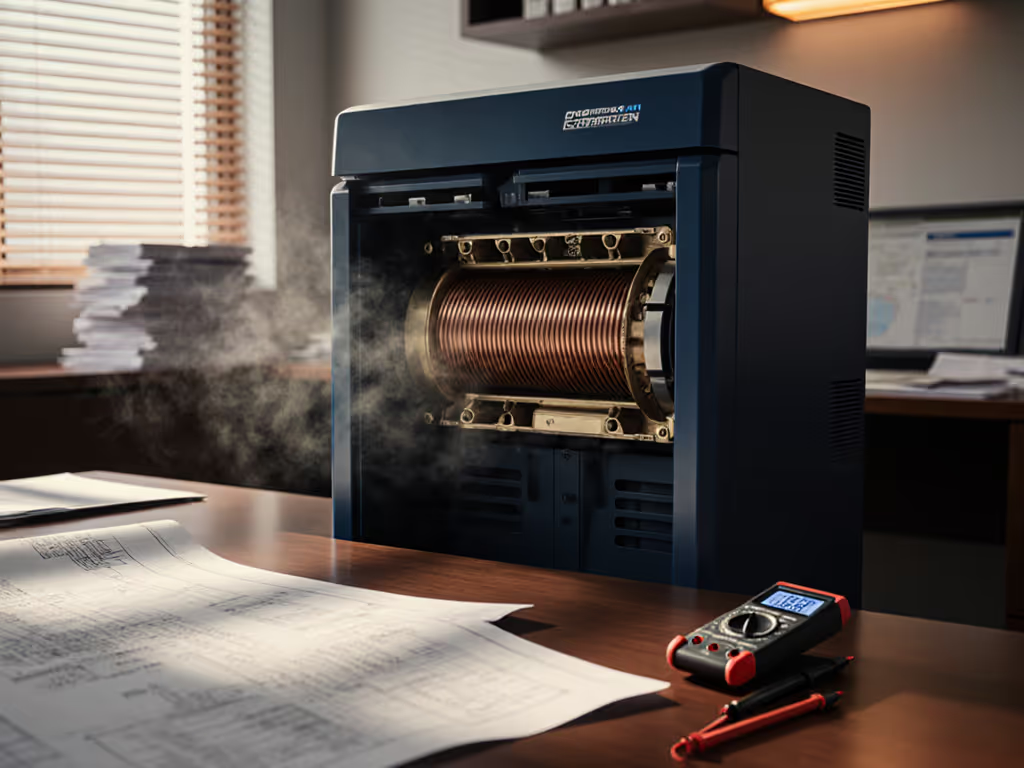
Shredder motor power and security level are directly connected, but not in the way most people think. The real question isn't "How powerful does my motor need to be?" It's "What's the minimum power required to destroy my specific documents safely and consistently?"
I've spent years mapping document categories to DIN levels, and I learned early that overpowered shredders don't mean oversecure disposal. They mean wasted energy, unnecessary noise, and a tool that's harder to fit into your workflow. The sweet spot lies in matching motor strength to actual document risk, not marketing hype.
How Motor Power Relates to Security Levels
Q: Do higher DIN security levels always require more motor power?
Yes, but with important nuance. Motor power increases because finer cuts demand more work from the motor. A DIN P-4 cross-cut shredder (producing strips approximately 2,000 mm² in size) requires less torque than a DIN P-5 or P-6 micro-cut machine (which fragments paper into tiny particles).
Here's why: micro-cut models require more cutting teeth engagement, demand higher torque to handle increased resistance, and take longer to process the same volume of paper. A typical home shredder operates between 100 to 500 watts during active use, with most models falling in the 200 to 350 watt range.
Match the document risk to the shred, not the hype.
This principle applies directly to motor selection. A P-5 shredder drawing 25% more power than a P-4 model isn't automatically the safer choice for your documents. It's only necessary if your documents warrant micro-cut destruction.
Q: What wattage does each DIN level typically require?
While manufacturers rarely publish exact wattage correlations to DIN levels (they focus on sheet capacity and noise instead), the general pattern is clear: micro-cut (P-5/P-6) requires 15 to 25% more power than cross-cut (P-4).
For most home users handling standard financial documents, medical records, and personal correspondence, DIN P-4 security represents the right-sized solution. This level provides adequate protection against reconstruction while optimizing energy use. For small offices handling client data, client documents, or regulated material, P-5 becomes justified, but not by default for every business.
Risk Category Mapping: When to Step Up Motor Power
Q: How do I know if I need higher motor power?
Start with a risk category map, not a product spec sheet.
Documents fall into three buckets:
- Low sensitivity (utility bills, printed advertisements, public notices): P-3 to P-4 suffices. Minimal motor demand.
- Medium sensitivity (bank statements, payroll records, cancelled checks, client files in non-regulated industries): P-4 to P-5 recommended. Moderate motor load.
- High sensitivity (medical records, tax returns, attorney-client correspondence, financial identity documents, HIPAA or GLBA client data): P-5 to P-6. Higher motor power justified.
I ran a records audit years ago where we'd mapped document categories directly to DIN levels, labeled all collection bins, and logged every pickup. When the auditor arrived, that shred policy was the easiest win. We had consistency, proof, and zero confusion about what went where. It wasn't dramatic, just the right cut, used reliably, with simple documentation.
That boring approach is the model.
Q: What about cross-cutting vs. micro-cutting for my motor choice?
Cross-cut (P-4) uses less motor power because cutting happens in two dimensions. Micro-cut (P-5 and above) cuts in four dimensions, requiring more teeth, more passes, and more torque.
For medium-risk documents (most small office and home scenarios), cross-cut at P-4 is the sweet spot where enhanced security doesn't disproportionately increase energy consumption or motor strain.
Motor Strength and Continuous Run-Time
Q: Does a more powerful motor mean longer continuous operation?
Not necessarily. Continuous run-time depends on thermal management, not raw wattage. A 300-watt shredder with intelligent thermal cutoff (e.g., 60-minute duty cycle) will outperform a 350-watt model without proper heat dispersal.
Units requiring frequent cooling periods actually consume more energy overall due to the higher power draw during restart phases. When you're consolidating a week's mail into one session, a motor rated for sustained operation beats a higher-wattage motor that overheats every 15 minutes.
For home and small-office batch processing, look for shredders offering 30 to 60 minutes continuous run-time. For a deeper look at how run time and thermal design affect reliability, see our duty cycle guide. That's the practical range where motor power and thermal design work together.
Q: What's the relationship between amperage and security?
Amperage (the electrical current draw) scales with security level, but it's not a direct dial-up mechanism. Higher DIN levels require more sustained amperage because the motor works harder, longer, to achieve finer cuts. You won't find "P-4 = 2 amps, P-5 = 3 amps" comparisons because amperage varies by motor design, blade sharpness, feed rate, and paper thickness.
What matters operationally: higher DIN levels mean higher sustained amperage, which means better power supply stability. In shared office or home environments, that occasionally translates to visible voltage dips or breaker sensitivity, a reason to avoid daisy-chaining shredders on overloaded circuits.
Home vs. Office Power Needs
Q: Do home and office shredders require different motor power strategies?
Yes. Home users typically shred 5 to 15 minutes per session, 1 to 3 times weekly. Office users shred longer, more frequently, and often continuously.
A home user clearing Friday mail with a P-4 cross-cut shredder (200 to 250 watts) completes the task efficiently. That same user buying a 400-watt P-6 micro-cut unit pays more upfront, draws more energy, generates more heat, occupies more desk space, and often runs noisier, for documents that don't require P-6 destruction.
Office managers handling client files, payroll, or regulated documents benefit from higher DIN levels (P-5 standard; P-6 if HIPAA/GLBA applies). Here, stepped-up motor power and longer duty cycles justify the investment.
Q: What's the energy cost difference?
For a typical home scenario (shredding 10 minutes per session, 52 sessions annually at 300 watts), annual energy consumption is modest. The gap widens when you compare motor efficiency. A shredder with intelligent auto-off and thermal management reduces energy waste by eliminating unnecessary restarts and extended idle time. Eighty percent of a shredder's energy footprint comes from operational inefficiencies rather than active shredding.
This means buying a slightly lower-wattage shredder with smart thermal management often beats a higher-wattage model without it.
Practical Chain-of-Custody Considerations
Q: Does motor power affect chain-of-custody compliance?
Not directly. Motor power doesn't prove destruction; a shred log does. However, adequate motor strength ensures consistent, reliable cutting, which is what auditors verify.
For organizations handling sensitive data, chain-of-custody documentation (pickup logs, shred dates, batch confirmation) matters far more than shredder wattage. Get started with our small business document destruction policy guide to build simple, audit-ready procedures. Pair a P-4 or P-5 shredder rated for your batch volume with simple, repeatable logging steps, and auditors move on.
Motor power becomes relevant only if the shredder fails under your actual workload. Underpowered equipment that jams, overheats, or shreds inconsistently compromises the entire process.
Finding Your Right-Sized Motor
Q: How do I choose the correct motor power for my documents?
Start with three inputs:
- Document risk: Map your typical mail/documents to low, medium, or high sensitivity. DIN P-4 handles most personal and small-office needs.
- Volume and frequency: Daily, weekly, or monthly batches? 5 minutes or 30 minutes per session? This determines required duty cycle, not necessarily wattage.
- Space and noise tolerance: Shared office or apartment? Compact footprint and quiet operation (often achieved through thermal design, not lower power) matter more than raw wattage.
Once you've mapped those factors, ignore the wattage spec. Focus instead on:
- Continuous duty cycle (30 to 60 minutes for typical home/small-office use)
- DIN rating that matches your risk category
- Thermal protection and auto-off features
- Sheet capacity per load (how many sheets before clearing)
Power consumption becomes relevant only for energy billing and circuit load, not security.
Next Steps: Audit Your Actual Needs
Privacy is a process, not a purchase. Before selecting a shredder, spend one week tracking:
- What documents you're actually shredding
- How long each session takes
- How many sheets per load
- Any frustrations (jams, overheating, noise complaints)
Then map that real-world snapshot to a DIN level and duty cycle. A P-4 shredder with 45-minute continuous operation and intelligent thermal management solves 90% of home and small-office problems, without excess motor power, noise, energy waste, or cost.
The right shredder isn't the most powerful one on the shelf. It's the one matched to your document risk, volume, and environment. That consistency is what auditors verify, what colleagues don't resent, and what your energy bill thanks you for.
Related Articles