Best Shredders for Veterinary Clinics: Quiet & Compliant
By David Okoro • 6th May
Introduction
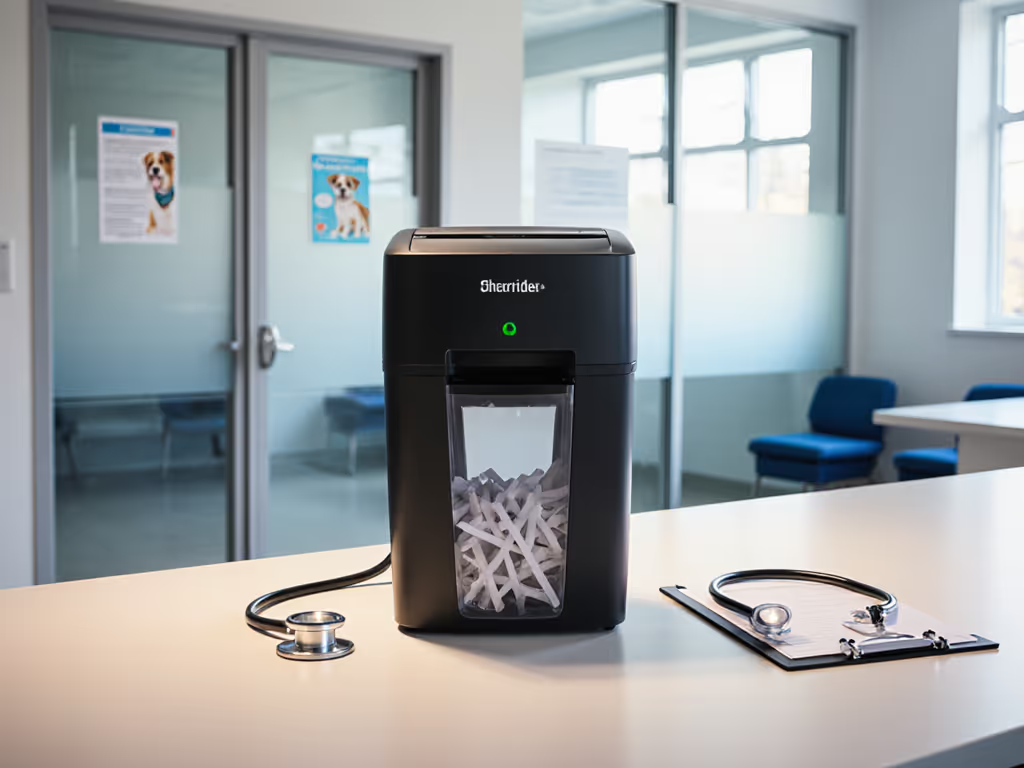
Veterinary clinics handle sensitive data daily: patient names, pet medical histories, vaccination records, payment information, and lab results. Unlike general retail offices, animal medical record security carries both ethical weight and legal teeth. HIPAA-adjacent standards, state veterinary board regulations, and growing consumer expectations around privacy mean that document disposal isn't a back-office afterthought, it is a compliance necessity. Choosing the right veterinary clinic shredders for your practice isn't just about stripping papers into confetti; it's about designing workflows that prevent jams, minimize noise in a calming clinical environment, and make proper destruction a habit your team will actually follow. This guide walks you through the analytics that matter, the security levels that make sense for veterinary practices, and the maintenance intervals in minutes that keep reliability high and hassle low.
Why Veterinary Clinics Need Dedicated Shredders
Vet clinics aren't law offices, but they're close cousins in the regulatory sense. Your clinic likely processes patient intake forms with pet owner contact and payment details, medical records including diagnoses and treatment notes, payment card and insurance information, lab reports and pathology notes, vaccination certificates, and licensing paperwork.
A compromised paper bin or unsecured dumpster can expose client data and damage trust faster than a surgical error. At the same time, vets are perpetually time-poor. The ideal shredder does its job quietly (because stressed animals don't need paper noise), quickly (because front desk staff have appointments to book), and reliably (because jams during peak hours mean missed schedules and frustration).
Key Selection Criteria for Veterinary Clinics: A Numbered Guide
1. Security Level: Match DIN P-Level to Your Risk Profile
Not all shredders are equal, and buying more security than you need is waste; buying less is negligence.
- DIN P-2 (Strip Cut): Produces long strips. Not sufficient for medical records. Fine for promotional flyers or outdated price lists.
- DIN P-3 (Cross Cut): Shreds into rectangular particles (~6×25 mm). Acceptable for routine administrative papers in most U.S. veterinary contexts, confirmed by guidelines for general healthcare record disposal.
- DIN P-4 (Fine Cross Cut): Shreds into smaller particles (~6×18 mm or finer). Recommended for veterinary clinics. Covers medical records, payment info, and client details with a security margin that reflects the stakes.
- DIN P-5 and P-6 (Micro Cut & Ultra Micro): Produce confetti-like particles. Overkill for most clinics unless you're handling DEA-controlled substance logs.
Action: Confirm your state's veterinary board guidelines and your liability insurance policy. Most clinics find P-4 security level is the sweet spot: strong enough to satisfy audits, not so extreme that it slows throughput or drives cost sky-high.
2. Jam-Risk Grading: Auto-Feed Reliability Over Raw Speed
Here's a truth learned the hard way: a shredder that jams on Tuesday morning when you're booked solid is worse than a shredder that runs slow but steady. Some high-speed models that tout 20-sheet capacity jam on their 15th sheet if users stack thick envelopes or mix paper weights.
Look for:
- Auto-feed or assisted-feed slots that reduce user stacking errors
- Reverse function that backs out jams without tool-assisted disassembly
- Thermal overload cut-off that halts operation before motor strain
- Transparent or translucent bin so staff see fill level and don't overstuff
- Real user reviews mentioning jam frequency under mixed documents
A practical measure I've observed: clinics that trained staff to "stagger, don't stack" (feeding batches one or two sheets at a time rather than shoving a full handful) cut jam rates by 80%, even on modest 8-sheet models. Small habits, big reliability.
3. Noise Profile: Decibels in Context
Veterinary clinics are healing spaces. A shredder that sounds like a small jet engine stresses animals and staff alike. Yet "quiet" is subjective without numbers.
Key specs to compare:
- Operating noise level (dB): Look for models rated at 65 dB or below. For context, 65 dB is roughly a phone conversation; 75 dB is a vacuum cleaner.
- Peak noise during jam or overload: Some shredders spike to 80+ dB when struggling with thick material.
- Vibration isolation: Rubber feet or acoustic mounting reduce transmitted noise to desks and floors.
Pro tip: If your clinic has an open reception area adjacent to exam rooms, prioritize models under 65 dB. If the shredder is in a private office or back room, 70 dB is often acceptable. For lab-measured comparisons, see our quiet shredder decibel tests.
4. Duty Cycle & Run-Time: Match Clinic Volume
Shredder duty cycle is the percentage of each hour a shredder can run continuously without thermal shutdown. A 20% duty cycle means: run for 12 minutes, cool for 48 minutes. A 60% duty cycle means: run for 36 minutes, cool for 24 minutes.
Estimate your clinic's volume:
- Small clinic (1-2 vets, < 80 patients/week): ~50-100 pages/week to shred. A 20% duty cycle shredder is fine; you'll rarely hit continuous 12+ minute runs.
- Medium clinic (3-4 vets, 150-250 patients/week): ~200-400 pages/week. Aim for 40-60% duty cycle to handle end-of-month purges without forced cool-downs.
- Large clinic (5+ vets, 300+ patients/week): ~600+ pages/week. A 60%+ duty cycle or commercial-grade continuous-duty model justifies the cost.
Overheating is an underrated annoyance. Underpowered models force 15-20 minute cool-downs per shift, and that is frustration, lost productivity, and eventual resentment toward the tool itself.
5. Sheet Capacity: Real-World Testing, Not Marketing Claims
Manufacturers state sheet capacity at 20 lb. bond paper, standard orientation, dry conditions, with user feeding optimally. Your clinic's reality is different: mix of 20, 24, and 28 lb. paper, junk mail with windows (heavier), the occasional stapled bundle, and users who sometimes feed faster than recommended.
Conservative rule: Divide the stated sheet capacity by 1.3. An "18-sheet" model often runs reliably at 12-14 sheets with real mixed documents. A "12-sheet" model sits at 8-10 sheets reliably.
For veterinary clinics: A 12-14 sheet true capacity is sufficient for routine intake forms and small batches. Only jump to 18+ if you're batch-processing bulk purges weekly and your team is trained in proper feeding.
6. Bin Capacity & Ergonomics of Emptying
Paper dust is invisible and pervasive. For real-world results on container size and efficiency, see our bin capacity performance guide. A small, frequently-overflowing bin means staff empty it multiple times daily, doubling mess and frustration. A too-large bin is awkward to lift and move for incineration or recycling.
Practical bin-change ergonomics:
- Capacity: 9-14 liters for small-to-medium clinics. This translates to roughly 200-400 sheets of mixed documents before filling.
- Height: Bin should sit below waist level (easier to extract without strain) or be mounted on a small cabinet with wheels.
- Visibility: Translucent walls let staff see fill without opening. A fill-line indicator prevents overstuffing.
- Closure: Dust-sealing lid or bag mechanism reduces spillage during removal.
- Dust callout: Models with built-in static-suppressing liners or bagless bins with electrostatic chambers lower the "confetti shower" risk when emptying. For clinics sensitive to dust (allergy-prone staff or adjacent to sterile areas), this is worth the premium.
7. Maintenance Intervals in Minutes: Oiling, Cleaning & Reliability
A shredder that demands professional servicing every three months or oil-and-alignment rituals weekly isn't a tool, it is a burden. Clinics are understaffed; maintenance-heavy equipment gets neglected and then fails.
Low-fuss design indicators:
- Oil-free or sealed-blade cartridges that ship pre-lubricated and need no user intervention or only yearly wipe-downs.
- Manual oiling (if required) on a clear interval: e.g., "oil for 30 seconds every two weeks" is acceptable; "oil every 20 shreds and monitor blade alignment" is not.
- Transparent dust access: You can visually inspect and blow out dust accumulation without disassembling.
- Quick jam-reversal: Backward button clears most jams in < 10 seconds; manual blade access not required.
- Warranty coverage: 2+ years on blades and motor; parts availability through the manufacturer, not proprietary or discontinued.
Low-fuss habits beat heroics when the bin hits full.
I've maintained shared equipment in offices and schools for years. The machines that earned trust weren't the ones that never broke; they were the ones that forgave imperfect use and recovered quickly when something went wrong. That forgiveness matters on busy clinic days.
8. Mixed-Media Compatibility: Staples, Clips & Credit Cards
Vet clinics process varied paper: envelopes with windows, stapled multi-page records, occasional insurance forms with metal fasteners, and shredded credit card offers.
Confirm the shredder handles:
- Staples & metal fasteners: Most P-3 and P-4 models do, but check the spec sheet.
- Credit cards (if you process payments on-site): Some models have a dedicated card slot; others handle it mixed with paper.
- Window envelopes: The plastic window can catch on blades if it's not auto-separated. Machines with pre-shredding pathways are safer.
- Adhesive labels and stamps: Newer cross-cut designs are more forgiving than older machines.
Don't assume. Request compatibility confirmation in writing from the vendor before purchase.
9. Size & Placement: Space Constraints & Airflow
Vet clinics are dense. Back offices are often cramped: reception desk, filing, computer, phone system, now adding a shredder.
Measurement checklist:
- Footprint: Typical models range 12 x 18 inches to 18 x 30 inches. Measure your intended space (under a desk, on a rolling cart, in a closet) and compare to spec sheets.
- Height: Ensure lid clearance for inserting documents and removing the bin.
- Venting: Shredders expel warm air and paper dust. Position away from HVAC returns or enclosed cabinets that could trap heat and trigger thermal shutdown mid-use.
- Power proximity: Cord length typically 6-8 feet. Avoid extension cords and daisy-chaining with other high-draw devices.
Hidden benefit: A mobile base (wheeled cart) lets you move the shredder for cleaning and repositioning during seasonal deep-cleans, reducing permanent dust shadows.
10. Auto-Shutoff & Safety Features
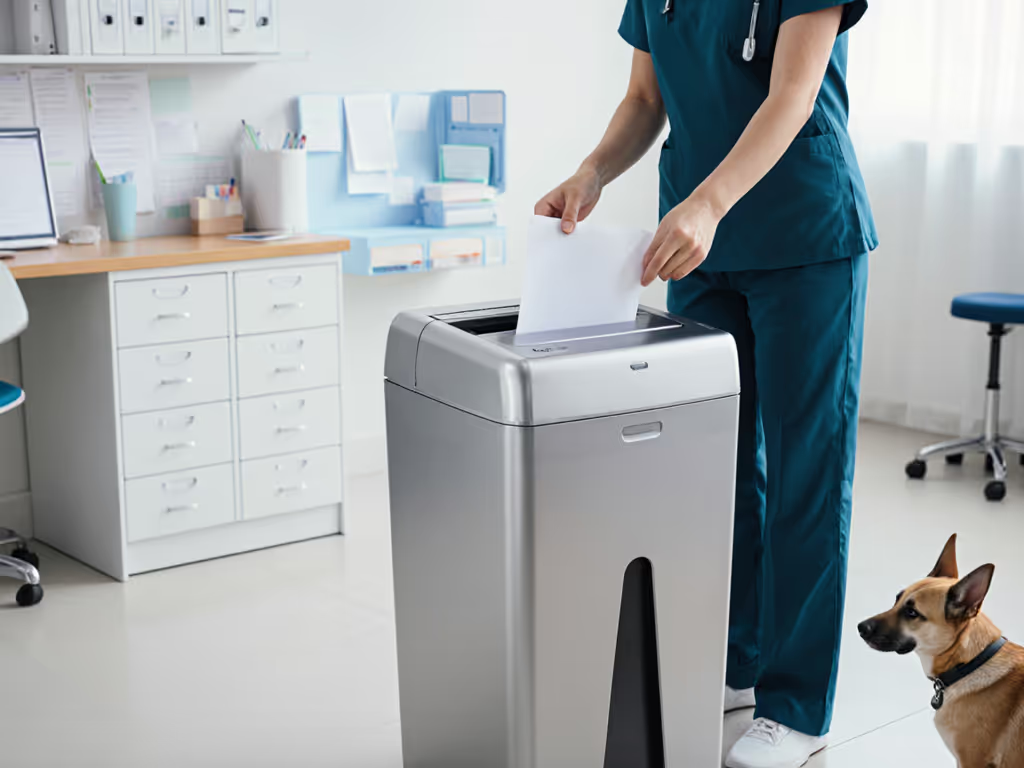
Clinics have curious clients, nervous animals, and staff in a hurry. An auto-shutoff that halts the shredder if a pet nose or child's hand nears the opening isn't just feature-bloat, it is peace of mind and compliance with modern safety standards.
Non-negotiable features:
- Auto shutoff after idle time (typically 3-5 minutes without paper fed).
- Thermal protection that trips before the motor overheats.
- Jam sensors that halt the motor if resistance spikes.
- No exposed moving parts below the feed opening.
Veterinary liability is complex. A child or pet injury near a shredder, even if user error, invites lawsuits and reputation damage. Modern machines excel here; don't buy a bare-bones design.
11. Cost-to-Value & Warranty Clarity
Shredder prices for veterinary clinic use typically range $200-$1,200 depending on security level, duty cycle, and noise profile.
Value matrix:
- Under $300: Entry-level P-3 or basic P-4, 8-12 sheet capacity, 20% duty cycle. Good for small solo practices with light, steady volume. Risk: frequent overheating or jams under peak load.
- $300-$600: Solid mid-range P-4 models, 12-18 sheet capacity, 40-60% duty cycle, quiet operation (<65 dB), low-fuss maintenance. Sweet spot for most small-to-medium clinics.
- $600-$1,200: Commercial or high-volume P-4/P-5 models, 20+ sheet capacity, 60%+ duty cycle, noise-damped enclosures, advanced auto-feed, extended warranties (3+ years). Justified if you're a large clinic or processing 600+ pages/week.
Warranty red flags:
- Warranty limited to 1 year on blades (should be 2+ years).
- Fine print that voids warranty if you use third-party oil or cleaning agents.
- Warranty that requires annual professional servicing (cost-shifting to you).
Best-value indicator: Models with 2-3 year warranties on blades and motor, clear user-serviceable parts lists, and spare parts available through mainstream retailers or the OEM dealer network. Avoid proprietary designs that lock you into a single service vendor.
12. Compliance Documentation & Audit Trail
Some clinics operate in regulated environments where compliance documentation is required, especially those involved in research, clinical trials, or subject to specific state veterinary board oversight.
Ask the vendor:
- Does the shredder come with a compliance certificate mapping cut level to relevant standards (HIPAA, state veterinary board, local record-retention law)?
- Can the vendor provide a signed statement that the model meets DIN P-4 standards (or higher)?
- Is there a suggested document-retention policy template or guidance specific to veterinary clinics?
For most clinics, this is background noise; for regulated practices, it's gold. If you need a primer on rules and frameworks, read our document destruction compliance guide.
Maintenance & Workflow Habits: Making Veterinary Practice Privacy Requirements Routine
Here's the truth: a perfectly-specified shredder becomes useless if no one uses it correctly. I trained teams in offices and schools, and the pattern was consistent. Clinics that reduced jams and frustration weren't buying $2,000 machines, they were building three habits:
- Feed batches, not stacks: One or two sheets at a time, slightly fanned, prevents compression jams. It feels slower but it's not; you're eliminating downtime and reversal drama.
- Empty bins before they overfill: Use the visual indicator as a rule, not a suggestion. An overflowing bin compresses shreds, blocks the feed, and makes emptying a mess event.
- Oil or maintain on a fixed calendar, not "when problems arise." A 30-second weekly wipe or monthly oil slot, blocked on the calendar like a recurring appointment, catches degradation before it becomes failure.
Assign these tasks to one staff member per shift rotation. Responsibility breeds consistency. Post a laminated checklist above the shredder. Done.
Actionable Next Steps
Here's how to move from research to decision:
- Audit your clinic's volume: Count pages shredded weekly for four weeks. Average the total. This number drives duty-cycle requirements.
- Confirm your security level: Email your vet board or liability insurance provider: "For routine medical records and client PII, is DIN P-3 or P-4 recommended?" Document their response.
- Walk your clinic and measure intended placement. Width, depth, height, proximity to power and HVAC returns. Note noise sensitivity (Is the shredder near exam rooms? Waiting areas?).
- Visit 3-4 shortlisted models in person or request spec sheets and real-user reviews. Prioritize models rated for quiet operation, low jam rates, and easy maintenance.
- Check warranty terms and spare-parts availability with the vendor. Ask for a reference clinic that uses the model.
- Make a purchase decision based on: security level (P-4), jam-risk grading (auto-feed, reverse, thermal protection), noise (<65 dB), maintenance intervals in minutes (clear, user-serviceable), and bin-change ergonomics (9-14L, easy seal, dust-control). Not on flash, novelty, or oversized sheet claims.
- Set a post-purchase training date. Get your team (front desk, reception, office manager) in a 15-minute huddle to cover feed technique, bin emptying, and maintenance rhythm. Small habits, big reliability.
Conclusion
Your clinic doesn't need heroic document destruction. It needs a quiet, reliable, low-maintenance partner that makes veterinary HIPAA compliance and pet health information security a routine, stress-free habit. The right shredder, matched to your volume and treated with simple discipline, is that partner. When you invest in the right machine and build the right habits around it, reliability isn't magic; it is the natural result of forgiving design and people who understand the stakes.
Related Articles