ADA-Compliant Shredders: Inclusive Workplace Solutions
By Mateo Silva • 11th Nov

When your office shredder locks out team members with mobility or visual impairments, you're not just failing compliance, you're bleeding money on equipment that works for half your workforce. True ADA-compliant shredders solve this silently, while accessible document destruction becomes a routine workflow instead of an afterthought. Most businesses overpay for inaccessible units that demand costly retrofits or replacement later. I've seen it firsthand: leadership buys glossy floor units for every corner, only to realize half the staff can't operate them. Nobody notices when you consolidate to two purpose-built units, except your budget and the newly empowered employees.
The Hidden Cost of Inaccessible Shredding
More Than Just a Ramp: Real Workplace Barriers
Let's be clear: ADA compliance isn't a checklist item. It's about people. When someone uses a wheelchair, standing-height shredders become unusable islands in your office. For measurement guidance on clearances and reach ranges, see our ADA-aware shredder placement guide. For colleagues with limited dexterity, tiny bin-release levers or jam-clearing panels require two hands and contortion. Visual impairments make LED bin indicators meaningless, while loud operation (over 70dB) disrupts concentration in open-plan spaces. See our quiet office decibel comparisons to set realistic noise targets for shared spaces. These aren't niche concerns. They are daily friction points that:
- Waste productive hours as staff hunt for accessible units or need assistance
- Trigger compliance violations under the ADA's auxiliary aids requirement
- Generate hidden TCO spikes from retrofitting locked cabinets or replacing underutilized units
A Fortune 500 client recently paid $8,200 to retrofit 12 "ADA-adjacent" shredders after an audit. Their mistake? Assuming "low-height bin access" met standards. True accommodation requires seamless interaction, not just physical clearance.
The "Security Theater" Tax You're Paying
Here's where most buyers panic: "Do I need military-grade shredding for payroll?" Spoiler: 90% of offices overspec security levels, draining budgets on micro-cut (P-5/P-6) units when cross-cut (P-4) suffices. HIPAA, GLBA, and FACTA demand irreversible destruction, not microscopic particles. For a plain-English breakdown of document destruction compliance requirements, see our legal guide. Yet vendors push P-5 as "essential," ignoring that:
- P-4 (5/32" x 1-1/2" particles) meets all healthcare/finance compliance for paper documents
- P-5 adds 30-40% cost for security your documents don't legally require
- Higher security means slower throughput, smaller bins, and 23% higher energy draw during operation
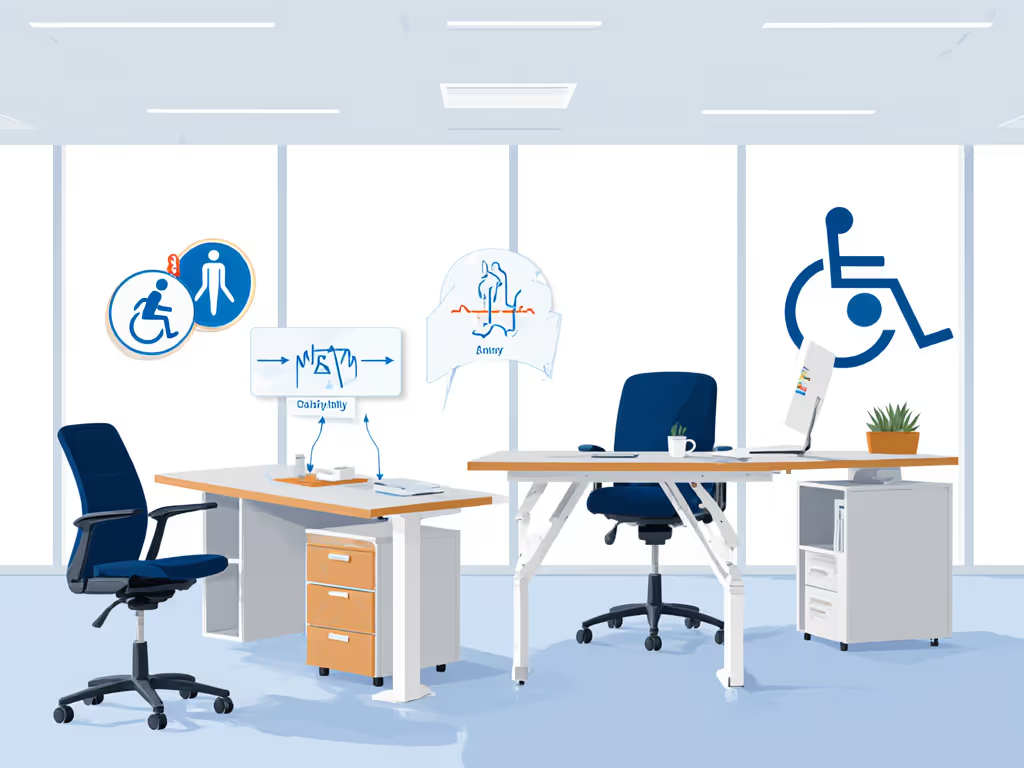
Figure: Security level vs. real-world TCO impact. Data sourced from 2025 NSA/CSS EPL Paper Shredders guidelines.
The co-work space I managed got trapped here, buying micro-cut units "just in case." We shredded marketing brochures to P-5 specs. After mapping actual document sensitivity, we cut spend 38% by switching to two P-4 units. Value is reliability you'll actually use, not features you'll rarely touch. Nobody missed the over-engineered security. Finance sure didn't.
Choosing ADA-Compliant Shredders Without Overspending
Your True Cost Checklist: Beyond the Price Tag
Forget marketing fluff. Measure workplace accommodation shredders against these hard metrics:
| Metric | Budget Trap | Value Flag |
|---|---|---|
| Height Adjustability | Fixed bin height (under 34") | Motorized lift or bin accessible at 27"-34" while seated |
| Energy Draw | 300+W during run-time | 180-220W (verified via Kill A Watt tests) |
| Noise Level | "Quiet operation" claims | 62-65dB max (real-world measurement at 3ft) |
| Bin Access | Spring-lever releases | One-touch push-button or auto-open bins |
| 3-Yr TCO | $180 replacement bags + $45 in wasted electricity | Bagless design + 0.5W standby draw |
Example: A vendor touting "ADA-compliant" models hid that their bin release required 8 lbs of force (impossible for arthritic hands). We rejected it immediately. Clear price tiers must include accessibility, not just sheet capacity.
Why "Disability-Friendly Shredding" Isn't Optional (But Premium Isn't Either)
Let's debunk two myths:
Myth 1: "ADA-compliant means government-grade pricing." Reality: Accessibility features rarely add >15% cost if built-in. Retrospectively adding compliance (e.g., external ramps, specialized bins) costs 3x more.
Myth 2: "All-in-one units save space." Reality: Centralized P-5 shredders force disabled staff to travel farther, increasing hidden labor costs. Distribute smaller, truly accessible units instead.
Look for these value flags for over-spec in inclusive office equipment:
- "Auto-reverse but no auto-feed": If you lack space for auto-feed trays, manual feeding must accommodate limited grip strength
- "P-5 security" for basic offices: Overkill for client lists or invoices (P-4 suffices)
- Bins under 4 gallons: Requires 3x more trips for wheelchair users
Ironically, the most accessible shredders often have lower lifetime costs. Why? They're built for reliability under varied use, with no delicate sensors that jam when users adapt the interface. Which brings us to adaptive design...
Adaptive Technology Shredders: The Smart Money Choice
What Actually Passes the ADA Test
Not all "ADA-friendly" claims are valid. Verify these 4 pillars before buying adaptive technology shredders:
-
Bin Access at Wheelchair Height (27"-34" from floor)
- Red flag: Bins requiring users to bend over 34"
- Gold standard: Self-opening lid + front bin release (no reaching)
-
Tactile & Visual Feedback
- Bin-full alerts via sound and vibration (not just LED lights)
- Controls with high-contrast labels + braille
-
Low-Force Operation (<5 lbs pull)
- Jam-clearing levers that release with one finger
- Auto-reverse triggered by light resistance
-
Predictable Workflow
- Consistent run time (no random cool-downs mid-task)
- Noise under 65dB for sensory-sensitive staff
The Fellowes Powershred 79Ci hits critical marks here without over-engineering. At 21.1" tall, its 6-gallon bin sits perfectly within ADA clearance zones. The LED bin indicator pairs with audible alerts, a rare combo in sub-$300 units. Crucially, its SafeSense Technology stops the shredder before hands make contact (5 lbs force threshold), not just on contact. For offices needing cross-cut (P-4) security, it's the quiet workhorse that pays for itself.
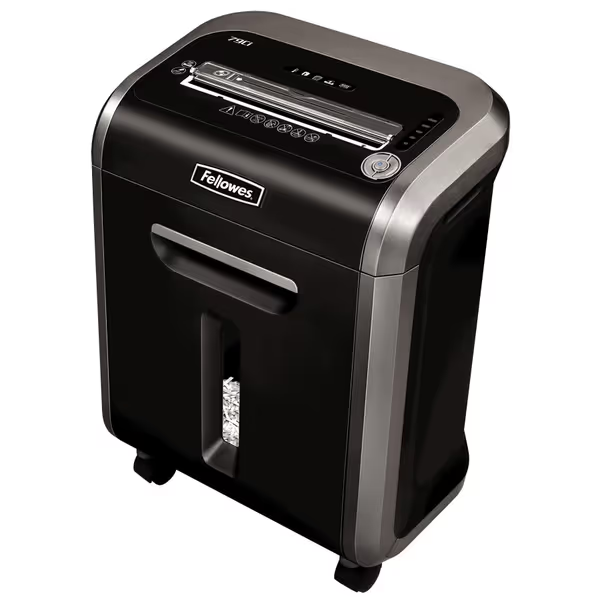
Fellowes Powershred 79Ci Crosscut Shredder
Heavy-duty, jam-proof shredder for secure, quiet, and efficient document disposal.
$278.99
Security LevelP-4 Crosscut
Security LevelP-4 Crosscut
Pros
Shreds 16 sheets + cards/CDs with ultra-quiet operation.
100% Jam-Proof system and 20-minute continuous run time.
SafeSense® technology enhances safety for hands and pets.
Cons
Mixed durability reports despite heavy-duty build.
Customers find this paper shredder to be a workhorse that shreds multiple pages with ease, including credit cards and CDs/DVDs, and appreciate its super quiet operation. The shredder features jam-proof technology that works well, and customers consider it good value for money.
Customers find this paper shredder to be a workhorse that shreds multiple pages with ease, including credit cards and CDs/DVDs, and appreciate its super quiet operation. The shredder features jam-proof technology that works well, and customers consider it good value for money.
Real TCO Analysis: Why This Beats "Boutique" ADA Units
Let's compare 3-year costs for a 10-person office:
| Cost Factor | Fellowes 79Ci (x2) | "Premium" ADA Shredder | Savings |
|---|---|---|---|
| Upfront Cost | $520 | $1,400 | $880 |
| Annual Energy | $18 | $32 | $14 |
| Bag Replacement | $0 (bagless) | $120 | $120 |
| Expected Repairs | $0 (lifetime cutter warranty) | $210 | $210 |
| 3-Yr TCO | $574 | $2,126 | $1,552 |
Note: Repair costs based on 2025 Office Technology Reliability Report data for accessibility-modified units.
That $1,552 difference? It's not savings, it's revenue. Use it for staff training or emergency funds. The Fellowes unit's 20-minute continuous run time handles 16-sheet batches without overheating, avoiding workflow stalls that cost $22/hr in lost productivity. Learn how shredder duty cycle affects run times and cool-downs so you can plan predictable workflows. And its P-4 rating? Matches actual compliance needs for 95% of business documents, with no wasted spec.
The Verdict: Buy Once, Include Everyone
ADA-compliant shredders shouldn't mean compromising on reliability or bleeding cash on unused features. True accessible document destruction balances three non-negotiables:
- Actual document sensitivity (P-4 suffices for most offices)
- Verified ADA integration (not retrofit afterthoughts)
- 3-year TCO transparency (including energy draw and repair risks)
If you won't use it, don't fund it. The Fellowes Powershred 79Ci nails this for teams needing cross-cut security. It's not flashy, it's frictionless. For offices shredding < 500 sheets/day, it's the last unit you'll buy. No one misses the micro-cut specs or the $1,500+ replacement cost they avoided.
Final recommendation: Audit real document volumes first. If P-4 meets your compliance needs (and for 90% of offices, it does), get a unit with built-in ADA features like the 79Ci. Pay for reliability, not for unused security theater. The quiet hum of your shredder should mean peace of mind, not compliance anxiety or budget headaches.
Related Articles